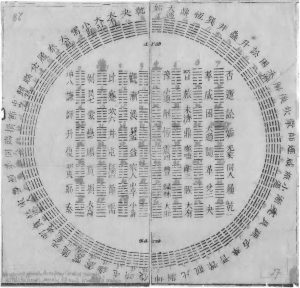
Also translated as The Classic of Changes, this is one of key texts of Confucian scholarship (together with the Book of Documents which contains the “Tribute of Yu”). For centuries people have used this text to navigate through difficult passages and decisions in life, relying on different methods to choose one of sixty-four hexagrams (sets of six lines). These describe nuances in different situations, and nothing is ever black or white, since all of it is based on the principles of yinyang theory. You can cast your own hexagram using the instructions given in the text, or trust the power of random and check out the hexagram in the sidebar on this website. (Reload the page for a new one!)
- Loewe, Michael. “China.” In Oracles and Divination, edited by Michael Loewe and Carmen Blacker, 38-62. Boulder: Shambhala, 1981. (PDF)
This is a short introduction to the main ideas about divination, oracles and omens. It is useful to refresh what you learned about omens, Five Phases and yin-yang theory and compare/refine your understanding. Loewe introduces three commonly used methods: “oracle bones” (which should be more aptly named “divination bones”), Book of Changes, and fengshui (Geomancy). What are the differences between divination, oracles and omens? What is the historical evolution for each of the three techniques?
- Cast your hexagram! Focus your attention on a question about your current situation or your future prospects, and let the Book of Changes bring clarity to your situation.
-
-
-
- If you’ve never done this before, this website has some good instructions on how to obtain your hexagram with coins. IMPORTANT Note that the first line you cast will be the bottom line of the hexagram; the last line will be the top one.
- You can easily find your hexagram’s number in the list on this website.
- Once you have your number (and name) of the hexagram, please go to the library website and find the following translation as an e-book, to find the text of your hexagram: (Do not use the translations on the websites used to find your hexagram):
Lynn, Richard John, and Bi Wang. The Classic of Changes : A New Translation of the I Ching As Interpreted by Wang Bi. New York: Columbia University Press, 1994. (e-book Trexler Library) - If you have “changing lines” (i.e. lines that move from yin to yang, or vice versa): Use this site to see what to do next
- Make sure to consult the “changing” hexagram in addition to your primary hexagram, and pay particular attention to the lines that change. This shows your situation is evolving and you need to take into account both hexagrams for guidance.
- The commentary to help you interpret the lines can be quite lengthy. Read on until you bump into the next hexagram.
- Jot down your understanding of the explanation of the hexagram and bring to class, together with your hexagram(s).
-
-
- Lai, Karyn. “The Yijing and Its Place in Chinese Philosophy.” In Karyn Lai. An Introduction to Chinese Philosophy. Cambridge Introductions to Philosophy, 199- 234. Cambridge, UK: Cambridge University Press, 2008. (PDF)
Additional resource with more information.
- Trexler Library search term: su:Yi jing
