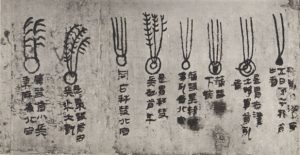
The Chinese have a long tradition of astronomical observations. The ruler was the Son of Heaven, and was seen as the linchpin which held heaven and earth in good balance. Solar and lunar eclipses that were not correctly predicted, comets, and the movements of the planets and stars were interpreted as signs from Heaven that the ruler should mend his ways, or he would fall from power. This led to a complex body of knowledge which combined five phases (wuxing) and yinyang theory with political and moral philosophy and mathematics into something more akin to astrology.
Texts and publications:
- Major, John S. Heaven and Earth in Early Han Thought: Chapters Three, Four, and Five of the Huainanzi. Albany: SUNY Press, 1993. (PDF)
-
- Translation from the Huainanzi (Master of Huainan) text, which contains a long section on the movements of the Heavens.
-
- Dong, Zhongshu. Luxuriant Gems of the Spring and Autumn. Edited by Sarah A Queen and John S Major. Translations from the Asian Classics. New York: Columbia University Press, 2016. (Trexler Library ebook)
-
-
-
- Group 8 contains several chapters connected with the Heavens.
-
-
-
Online resources:
- “History of Astronomy in China”, International Dunhuang Project. URL: http://idp.bl.uk/4DCGI/education/astronomy/history.html
- Dr. Jeffrey Kotyk’s blog “Huayanzang”: Dr. Kotyk specializes in the history of East Asian astrology/astronomy and its connections to the rest of the Afro-Eurasian continent. http://huayanzang.blogspot.com/
-
- He is also very active on twitter, and worth following for links to new publications, insights in his research and photographs.
-
